
INTERVIEW: Writer/Director Jing Ai Ng on Making ‘Forge’ The Genuine Article
As Writer/Director Jing Ai Ng points out, art forgery isn’t the easiest way to make a buck. It takes deep study, craftspersonship, and the chutzpa to pull it off. But it attracted Ng as a subject for her new film Forge, which is in theaters now. It must be how those same qualities are what are needed to be an indie filmmaker as well.
In Forge, siblings Coco and Raymond (Andie Ju and Brandon Soo Hoo) get dragged into a major artworld con after making small time forgeries in Miami, but the FBI and Agent Emily Lee (Kelly Marie Tran) are hot on their trail. Ng took the script for Forge through the Film Independent Screenwriting Lab, and Fast Track. Producer Liz Daering-Glass also took the project through the Producing Lab. We spoke about how those programs shaped the films journey, and how the line between art and theft isn’t as clear as we think it is.
You’ve mentioned that a lot of your earlier projects were more personal. What appealed to you about the crime genre for this one?
I grew up between Malaysia and Miami. My family splits time between those two places. Crime films were pretty standard fare for us, whether it was Hong Kong crime movies or Miami Vice. Culturally, the genre was very much embedded in my imagination. But I’m also genuinely fascinated by white-collar crime and what it means in America specifically. A lot of people don’t know this, but the art forger behind roughly $80 million worth of fraudulent art in New York was a Chinese man who fled the country and was never interviewed. I was really drawn to the idea of imagining a story around an art forger.
You mentioned that you got to speak with some real-life art forgers. How did you get in contact with them, and was there anything surprising you learned?
Some forgers are essentially public figures who are willing to talk. Others actually reached out to me. Either way, they were eager to share their side of things, which I found really interesting. As for what surprised me, more than any specific detail, it was understanding their motivations, which often seemed genuinely confused in a fascinating way. Art forgery isn’t a simple cash grab. You need a very particular set of skills to pull it off. So hearing how they each got into it in the first place was the most compelling thing for me.
Do you see any similarities between forging art and directing a film?
Absolutely! You’re actually the first person to ask me that, though it’s something I think about quite often. I think there are real arguments to be made across all art forms, and cinema is no exception, when it comes to inspiration and where you draw your references from. Every artist is obviously pulling from people who came before them. What portion of that is inspiration and what portion is a direct lift is genuinely up in the air — especially with cinema, because it’s such a dense cultural thread. I think every artist grapples with that to some extent, and film directors perhaps especially so.
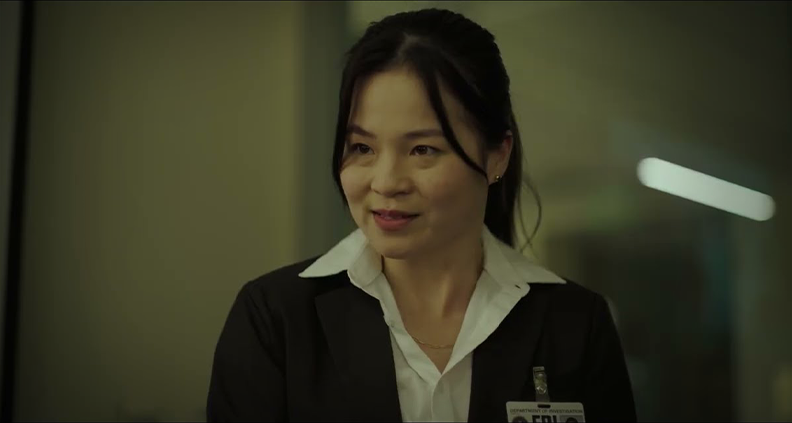
You have three Asian leads in the film. Why was that important to you, and what roadblocks did you encounter along the way?
When I first brought the film to the Film Independent Screenwriting Lab, the script was actually about two best friends, one Asian, one not. When I started reworking it to be more personal and closer to my own experience, the characters all became part of the same family. The FBI agent was always Asian. And once I was making this film with specific people in my head, it became a non-negotiable that I remain faithful to that vision and to my mission of making sure there are more films with Asian leads in America.
What’s almost funny is that Forge is a genre film with a premise I think a lot of people find genuinely appealing. Crime films have broad appeal, and art crime has its own fascination. It just happens to be a film where the art forgers are Asian. I thought that would make it a relatively simple pitch. It turned out to be far more complicated than I expected. I’m really glad I stayed stubborn throughout the entire process.
Tell me about your experience in the Screenwriting Lab and what changes came out of it.
As I mentioned, the script was completely different when I went through the Lab. I had two best friends as the leads, one of whom was the Asian character, Coco. The feedback I got from everyone in the lab was that they loved Coco but couldn’t connect with the other characters. I realized pretty quickly that it was because I was writing Coco from a deeply personal place. I felt close to her even though she was a criminal. The lab, both inadvertently and explicitly, encouraged me to be more true to myself in telling the story, even within a genre framework. That process really opened up my heart and mind as a director to be unapologetically myself.
I was twenty-five, maybe twenty-six, when I went through the Screenwriting Lab. Having that support system and that encouragement to be unapologetic about what I wanted to write and where I wanted to take the story catapulted the script from an early stage to where it ultimately ended up.
Can you tell me about your experience with Fast Track and how that contributed to getting the film made?
We went into Fast Track with a financing gap to fill and pitched to a lot of people, many of whom I’m still in touch with. I actually work with one of the companies we pitched to, Black Bear, though I wasn’t represented by them at the time. It was a great way to get in front of different people. And although we didn’t meet any of our executive producers directly through Fast Track, someone we met there connected us to other financiers. They said something like, “It’s not my cup of tea, but I know someone who would love it.” That person has been integral to the whole process.
What would you say to someone thinking of applying to a Film Independent Artist Development program?
I’d really like to encourage people to apply to the Labs — no matter how many times it takes or how long the process is. It was a genuinely important part of reaffirming myself as a writer. I didn’t know anyone when I applied; it was my first lab, my first development program. The lab took me in completely blind, and I’m so grateful for that. I hope that message comes through, but if it doesn’t: submit your scripts and your ideas. We always love to hear them.
Watch our Q&A with Jing Ai Ng and Kelly Marie Tran here:
Images courtesy of Utopia
Forge is playing in select theaters and will be coming to a home release later this summer.
Film Independent promotes unique independent voices by helping filmmakers create and advance new work. To support our work with a donation, please click here. Become a Member of Film Independent here.
Keep up with Film Independent…