
INTERVIEW: Director Penny Lane on Learning to See Through the Eyes of an Owl
Ask any filmmaker, and they’ll tell you that coming up with the idea for a film is one of the hardest parts of the process. The concept is what hooks an audience, but they’re elusive things. They don’t just pop onto your phone like a text message.
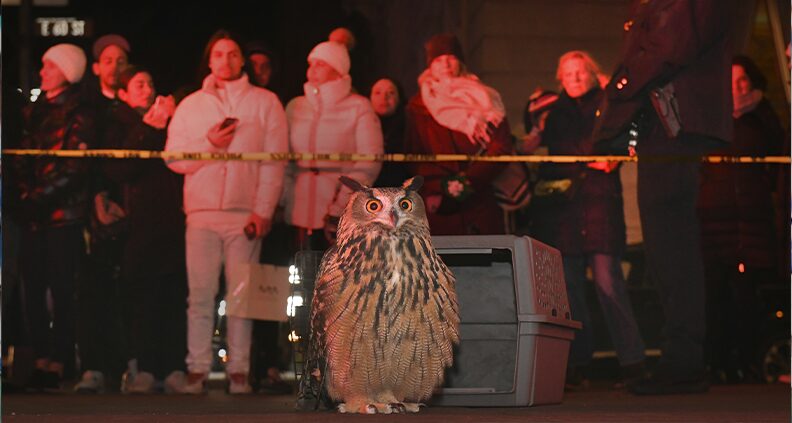
That is unless you’re director Penny Lane. A long time birder, Lane was sent a photo of a lost owl on the sidewalk on Fifth Avenue in Manhattan. “Those images were so engaging. I thought: Who is this owl? What is he doing on a sidewalk? Does he need help? ” she said. Her friend and fellow filmmaker Jeremy Workman came across the Eurasian Eagle Owl one night and thought of her [Ed Note: Watch our interview with Workman on his film Secret Mall Apartment].
The owl it turned out had somehow escaped from the Central Park Zoo and was named Flaco. Of course a loose bird on the street does not a feature-film make. Lane followed the story with interest, but the story didn’t solidify into a film until the zoo abandoned its attempts to recapture Flaco, and let him live wild in New York City.
Lane saw the passion both avid birders and everyday New Yorkers had for Flaco, and saw how looking at Flaco’s journey across the city could introduce new question:
Why does Flaco’s freedom resonate with us humans? What is the right thing to do with animals in captivity? How does our human perspective skew how we treat other beings? How should we look at the world?
Those issues are investigated in her new documentary Wild Inside, which premiered in Central Park, drawing a crowd of 1500+ and is now playing in theaters across the country, where it’s already grossed enough to make it a top 10 non-event documentary this year. We spoke with Lane about the film, and how broadening your perspective can lead to some unexpected places.
Tell me about how you first got interested in Flaco and how you decided this was a project you wanted to pursue.
So fun fact, the first person you hear from in the movie is a guy named Jeremy Workman. He’s the person who turned the corner and there Flaco was. Jeremy’s a very dear friend of mine.
He was sending them to me because he knew ‘Penny’s a birder’. Those images were so engaging. I thought: Who is this owl? What is he doing on a sidewalk? Does he need help?
I was immediately very invested, but I also knew it’s not normal for an owl to be on a Fifth Avenue sidewalk. It should be flying away. I just knew there was something very wrong.
I was the one who called the Wild Bird Fund, the rehab center, and I was tweeting out his location on Twitter because I thought maybe he’s a pet that got lost. I was involved from the instant that his story began. In earlier cuts of the movie, I tried to make that clear, but it was just very confusing for viewers to think Penny’s a character and I’m not. I just disappeared after the first five minutes. So we took it all out, but it’s fun context.
It didn’t turn into a movie idea until at least a month into the whole adventure, because by then the zoo had called off their rescue efforts and he was just going to live in the city. That was not the outcome that anyone was predicting.
To me, that was the story. I was watching this owl become an owl. And I felt like, as a long-time birder, I was ready. I’m a person who has read and thought deeply on the issue of what we owe our non-human neighbors. It was so deep inside me, my love of birds and my New York City birder connection. I feel like I was born to make this movie.
What was your thought process when it came to scripting?
You mentioned this was a story of Flaco becoming an owl. The film is so much about what this animal does, something as a filmmaker you have no control over. How did you see constructing a narrative?
The reason why I didn’t start the film until a month in was that the first month basically covers the first act of the movie. The first act is really what sets the table with all the questions and ideas that will follow: What will happen to Flaco?What will he do? How will he survive? Will he have a negative impact on the ecosystem?
When I was pitching it, I said, he’s going to die eventually because I know that owls and hawks don’t live long in New York City. They all die of rat poison. But I didn’t know if that would be five years or ten weeks. I also thought that he might just disappear.
I saw all these different paths of what could happen, but I had the first act in my head, and I knew that whatever happened would be worth tracing. That said, Flaco made all the decisions from that point on.
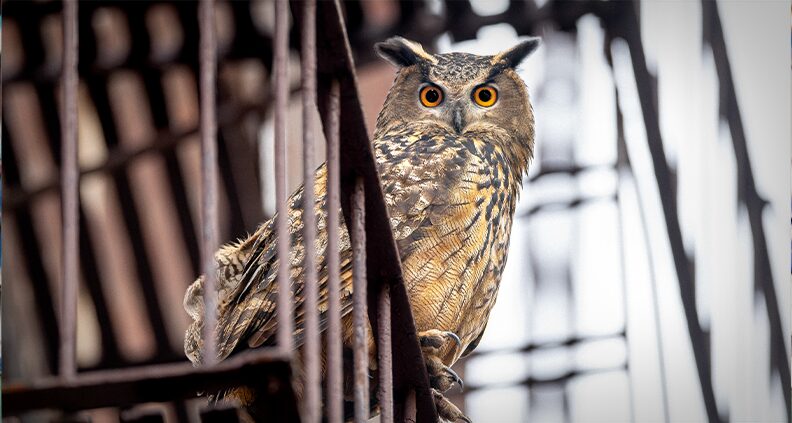
His choices ended up being great. Because first he chose to sit on his favorite tree, which was right on a major thoroughfare in Central Park. That is not what an owl would do. A normal owl would be hiding deep in the woods. It made the movie better. He was so fully on display for so long that every day there were crowds of people under the tree. That was amazing.
And then he left the park, which became the midpoint of my film. It’s a whole other chapter of him exploring these different neighborhoods, his mating behavior and the heartbreak that would never find a mate. He was exploring New York City, letting our cameras also explore New York City and get to know more people.
He also started hunting pigeons, which is part of what ultimately did him in. When he left the park, we all thought, ‘This is not good’ because there’s very little rat poison within the perimeter of Central Park. It’s a relatively safe place for him to eat rats. In residential areas, every single building puts out suitcases full of rat poison and every rat is full of it.
I was right to be worried. He only lived for a few months after that point.
When it comes to ‘casting’ the human characters, I’m sure that some of the birders you found through Flaco and being in the same places that they were but tell me about how you chose the ones to follow and then also a little bit about some of the other people who you found.
I started with the people who were already obsessively following Flaco day-in day-out, and that group was easy to identify from social media. I made friends with them and I think they liked the approach I was taking, and they thought I was respectful. That got me a long way in getting that cooperation.
The birders were first, and then as time went on, especially once he left the park, we wanted to meet people who had other types of encounters with him. We found that preschool class, they had been going to visit Flaco every week before he died and so that was how we connected with them.
I had an incredible producing team and three producers in the film and they were clutch. Because they were literally walking up and down the street everywhere Flaco had been seen, just talking to people. They were handing out flyers.
That’s how we found the food cart operator who had had this intimate experience with Flaco night after night, and the barber who not only had gotten these great photos of Flaco but was himself a wildlife photographer and was an expert on rodenticide.
And then in the edit, it was about distilling it down. The film’s a chorus. We interviewed a lot of people that didn’t make it into the movie, and they were all fantastic but ultimately, we needed each person to convey really just one or two ideas and convey them in the right time and place, and pin it to the board that way.
I want to talk to you also about anthropomorphizing. There is this tendency that we all have to want to create meaning in a story for Flaco. Ultimately though, his inner life is unknowable.
How did you balance that in the storytelling where this was part of the appeal versus deciding how responsible the impulse to anthropomorphize was?
It was a huge part of how the whole movie came to be. I would start by saying that we know that anthropomorphizing is a philosophical error. There are reasons that we should not assume that Flaco is just a person in an owl costume, like a Beatrix Potter character. He’s not. He’s an owl. He’s very different from humans in many ways.
There’s a kind of a dumb version of it that’s just like– he’s apartment shopping in the East Village. That’s obviously a joke. No one really thinks that, right? But it’s a funny, relatable thing. And I do think that most of that’s pretty harmless.
Where it gets harmful is when you start putting stories on the animals that are not true and they lead you to act in ways that are not true.
On the other end of the spectrum are people who are so afraid of anthropomorphizing an animal that they basically just refuse to imagine anything about what their inner life might be like. And I find that’s very common in the world of educated people who ‘know better’. That’s how we allow ourselves to mistreat animals, by assuming that there is nothing there, that they’re basically just unthinking, unfeeling machines. It’s so ridiculous. Anyone with a dog can see that.
I think we should look at the vast middle space here. I’m an animal. He’s an animal. We both want to do similar things in our lives.
It’s not crazy to think that I could use my imagination to try to empathize with Flaco, using the best scientific information I have– what do we know about owls? How do they see the world? How do they hear? What are their behaviors?
But storytelling is what I think is so interesting, because you said earlier, we can’t help but assign meaning and story to Flaco.
I think that Flaco’s life had meaning to him. I can only guess as to what that would feel like. Did he feel the warmth of the sun on his face as he’s sitting there in a tree feeling the sunrise for the first time in his life? Do I think he might have enjoyed that? Yeah, I do, actually. It doesn’t really hurt him to have these empathetic feelings.
But you can’t ask Flaco what’s best for him.
So much of the film is about humans getting to decide what we think is best for him. And that’s where the discomfort comes in, because a dumb kind of anthropomorphism would misunderstand fundamentally what an owl is or what they really need. I didn’t want to do that, so the film doesn’t do that, but people certainly do.
You’re a birder as well. Why is birding so special and what made you want to share the world in this film?
A lot of birders have this experience where one day, almost out of the blue, your consciousness switches on and you suddenly notice birds and then suddenly see that the world has been full of all this color and movement and life.
For me, it felt as if I’ve been deaf and blind my whole life and then one day this whole world opened up to me, and it’s such a remarkable feeling. I remember the day it happened. I was hiking in the redwood forest, and I had this moment with a Winter Wren, and I just became a birder that day with no preparation for this.
So as a documentary person, over the years, I had wondered if I could make a movie about birding but birding is super boring to watch and it’s very hard to translate what that is onto a movie screen.
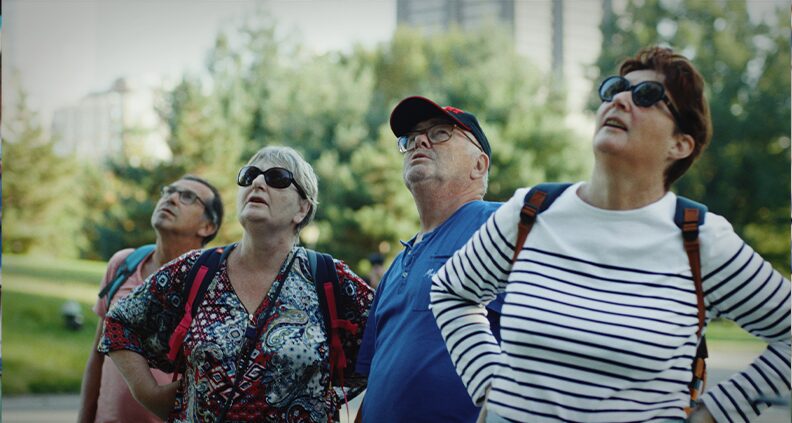
So that was why I felt like I was ready for this story when it came because I thought, this will be a way to help everyday people to look up and see. I always say look outside your window. You never know who might be on your air conditioner right now because most of the people that Flaco visited had no idea he was there. It’s not going to be Flaco next time but there are red-tailed hawks or mourning doves that do the same thing.
There’s a lot to see if you just look. I thought Flaco would be a great bridge for people to see what else they might be able to find if they just start looking.
Images courtesy of Sandbox Films: David Lei & Benny Polatseck
Film Independent promotes unique independent voices by helping filmmakers create and advance new work. To become a Member of Film Independent, just click here. To support us with a donation, click here.
Keep up with Film Independent…