
Industry Shifts: Insights on AI and Filming International from the Film Independent Forum
Two sessions at the forum spoke directly to brewing concerns in the heart of our moviemaking town: one, is AI taking over and two, can anyone in Los Angeles afford to live here, let alone make a movie?
Let me spoil it with the TL;DR that our panelists hold a lot of hope for both concerns, and surprise: it comes down to human relationships and partnerships. Connecting with collaborators, connecting with audiences, connecting with new ideas and perspectives from a diversity of backgrounds… basically everything that Film Independent stands for.
So let’s dig in. Reality Check: AI in the Workplace brought together three industry professionals and an economist, moderated by journalist Carolyn Giardina. Patrick Adler kicked things off with a rousing overview of creative jobs in California and how AI tools are affecting jobs on a broad scale. Speaking as a founding partner of Westwood Economics, his team published a report on the 118,000 creative jobs lost in California since 2022. The report is doing detective work on what differentiates this change in California from the rest of the country, where industries adopting AI tools have actually seen growth in the human workforce. Adler surmised that as AI tools have become more involved in some jobs, more people have been required to manage and implement those tools. But the unique factors of recession and livability for California and Los Angeles specifically could play a role.
Harry Yoon (Editor, Spider-Man: Brand New Day) recognized how AI has made it more streamlined and less tedious to complete “soul-crushing” tasks like transcription or building out new concepts with sound design and ADR drafts to test out new lines, leaving humans to do more of the fun stuff. Mathew Cullen (Founder of Mirada Studios, Motion Theory) has also found that work is streamlined through the use of AI, but that clients tend to be misinformed about what AI can actually do. No matter what they’ve heard, you can’t just prompt your way to a cinematic and artistic result – the role of human experience, human skill and human interaction is still vital.
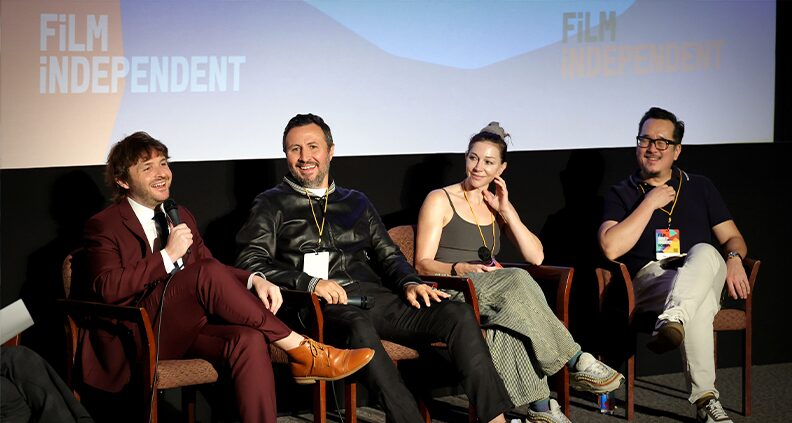
As a writer on the other hand, Ruth Fowler (Writer, Rules of the Game, Little Disasters) finds that gainful employment has always been challenging, but in the reality of AI involvement she’s being asked to do more free work – take more meetings, create more development documents – before knowing if she’s landed the job. But beyond the usual hustle to get work that covers a year’s salary, she wonders if AI is making writers even more isolated than usual. The experience she has gained from getting notes and pushback from fellow humans only translates to Claude if she trains it to; a newer writer may not benefit from that critique. Meanwhile, busyness and overwhelm make soliciting feedback from humans as difficult as ever.
Yoon and Cullen echoed concerns about what brings humans together at work, as the same tedious tasks AI handles might previously have functioned as training ground for an intern. The mentorship space is being affected, as Cullen reflected on starting his company in 2003 and training up new people. “My intern at the time is now the head of creative at my company. I think about all those interns, and I think about all those people that you know were sort of there, and you’re kind of creating that space for them to show up and figure it out.” Cullen has seen receptionists go on to be producers and directors that have won Emmys, all from the osmosis of being around imaginative people, seeing future possibilities up close.
There were also takeaways that could be used when audience members got home. VFX supervisor and Creators Coalition on Artificial Intelligence founder Jim Geduldick just launched the CCAI site, which includes useful tools for filmmakers like an AI terms glossary, and an impact survey and visualizer and be found here.
The panel tackled concerns about AI changing job descriptions and how much cost savings will matter, especially now that it’s more expensive to hire domestically versus overseas – even London is cheaper than Atlanta. Cullen accepts the encroachment of AI technology but doesn’t like it. Even so, he asserted that the creative business has never been more exciting or more challenging. “From short-form to long-form to interactive form to experiential … longevity is living in that river of change, you know?”
Meanwhile as so much production work moves offshore, how much cheaper is it as an independent filmmaker to take your film abroad? Crossing Borders: The International Landscape for Indies brought together five filmmakers to swap stories and highlight pros and cons for taking your production global. While the US does not currently have any international co-production treaties, our panel highlighted the importance of finding partners in the country that interests you. And by partners, Anna Różalska (EP for Who Will Write Our History and Co-Producer of Arbitrage) means true believers in the project – like-minded collaborators who want to see the story succeed. When shooting a project in Lithuania, Różalska described asking multiple companies to read the script and suggest a budget. Ultimately her choice was motivated by the ideas presented. “It wasn’t about eventually the budget, but about a company that really cared about the project … we could really tell they were very much involved.”
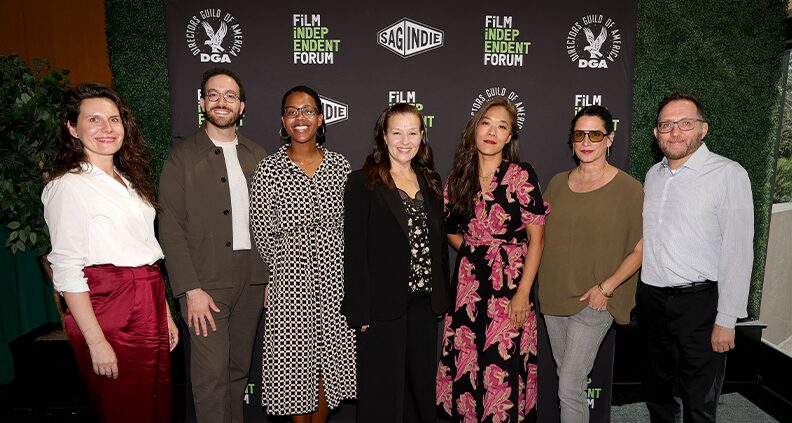
Shih-Ching Tsou (Director/Producer, Left-Handed Girl) is from Taiwan but lives in New York and had never made a film in her home country. So partnership was key. “It’s not really that exotic, because it’s really scary,” she says of trying to prove herself and her vision in the Taiwanese film industry. “People will look at you and say … ‘I don’t think you know what to do,’ right? So you kind of have to jump in there and kind of prove to them, like this is the way.” Communication and trust are key elements to any partnership, and Munir Atalla (Head of Production & Acquisitions, Watermelon Pictures) asserted that international relationships are no different.
Claire Brooks (Executive Director, Association of Film Commissioners International) shared with passion about the practicalities of identifying potential locations and making the most of the local film commission – even within the United States. “They provide free location services,” Brooks explained. “Some of them will read your script. Some of them have access to funding opportunities – not through their office, but through their national bodies.” And those that don’t can point you to the right place. Miura Kite (President of Global Content, Maria Farinha Films) has partners at a French production company and the two companies bring shows to each other, taking the lead based on who pays for what. “Once you do find people you love working with, try to maximize it in any way.”
In addition, moderator Tatiana Kelly (Producer, The Catcher Was a Spy, Cut Throat City) guided the panel through high level thoughts on attracting foreign investment, selling the finished project worldwide, the marketing potential of attaching stars, and keeping an open mind for the long view – “Talk to people,” Tsou suggested, “you never know who you’re gonna meet.” Brooks told a story about cultural alignment, and how The Substance earned a tax incentive from France because Demi Moore’s character cooks a French dish in one scene. “Read the details,” she summarizes on the importance of knowing what a given region is looking for when considering investment. Also not to be overlooked is cultural differences, unique aspects of local film industries and traditions, and holidays. If France is on vacation for the month of August, that will impact your production schedule.
“Travel a lot,” Różalska recommends. “I think the only way to really like connecting with people from different countries is through understanding their culture.”
While it’s easy to romanticize opportunities that are farther afield, panelists advised taking all considerations into account. Public financing can take 2-3 years. If tax incentives are refunds on expenses already incurred, then consider the interest on those expenses until you get paid. Brooks recommended getting a regional film office involved as soon as possible so they can help discern how the numbers will play out in real time and money. “When are you getting that money and how long are you carrying that loan, and is it worth it?”
Różalska lives in LA, going back and forth to Europe to make films. She was optimistic about the potential for great international film partnerships. “You all live in Hollywood and the whole world is looking up to you,” she said with a smile. Her European origins taught her the value of treaties and the amazing opportunities to collaborate across national borders. “I do believe the best way to make films is to really find different ways to collaborate and really take what’s best from both worlds.”
Maybe the same can be said for AI.
Film Independent promotes unique independent voices by helping filmmakers create and advance new work. To become a Member of Film Independent, just click here. To support us with a donation, click here.
Keep up with Film Independent…