
Healing Through Art and Reconstructing Shakespeare’s Globe Theater with ‘Hamnet’ Set Decorator Alice Felton
For more on Hamnet, join us this Thursday, February 26, for an intimate conversation with the director in “An Evening With …. Chloé Zhao.”
***
A cinematic meditation in grief, loss, and healing through art, Chloé Zhao’s Hamnet is based on Maggie O’Farrell’s novel by the same name. The period drama reimagines William Shakespeare’s (Paul Mescal) stage play Hamlet as being inspired by the death of his son, Hamnet (Jacobi Jupe). The Shakespeare household’s life is told through the lens of his wife and herbalist, Agnes (in an agonizing and powerful performance by Jessie Buckley), as they move from courtship and marriage to unspeakable grief when Hamnet dies.
Zhao, a Spirit Award winner and Screenwriting Lab Fellow, co-wrote the screenplay with O’Farrell and entrusted the set dressing to one of two set decorators, Alice Felton (along with Niamh Cunningham), who is part of the production design team under Fiona Crombie. Throughout the film, Felton’s set dressing evolves to chart the family’s emotional spiral as they wrestle with love and loss.
Days after scoring her second Oscar nomination for Hamnet as part of Crombie’s team (following 2019’s period dark comedy, The Favourite), Felton spoke with Film Independent about her work on the film, which has nabbed eight Oscar nominations.
Congratulations on your second Oscar nomination!
Thank you! We’re so happy, especially for a small artistic film like this. It’s amazing to be recognized in this way.
How big was your team and how long did you work on this film?
Because Fiona and I know each other really well, I often know about projects very early and start thinking about it before working on it. I normally have about 12 weeks of prep. Most of my 2024 was on Hamnet.
What was your first impression when you first read the script?
It was pitch perfect from the beginning. Very similar to when I read The Favourite, I also couldn’t stop turning the pages of Hamnet, I finished it in one go. From a set design perspective, the world was completely contained, which is so exciting because you realize the potential for ideas.
What do you mean by a “contained” world?
Even something like Cruella where I dressed 120 sets, its visual world was very tight. Similar to this, there’s a visual storyline that runs through the spaces. Other scripts may run through different worlds and planets. But when it’s so contained, it can be very precise. In Hamnet, because we experience Shakespeare and Agnes’ life through her eyes, we move through her life in a very contained way. We’re not in the streets with thousands of people or running through markets with lots of stunts. It’s a very contained and thoughtful, emotional story. My first thought was, this really hangs on those twins — if we don’t believe in these children and their domestic world, then we’re not going to care about anything else. Even though the love story between Will and Agnes is really beautiful, we need to care about the family. So, creating the family home and that domestic world was very important to bringing context to their world.
What were the texture and tone that you had in mind as the story unravels?
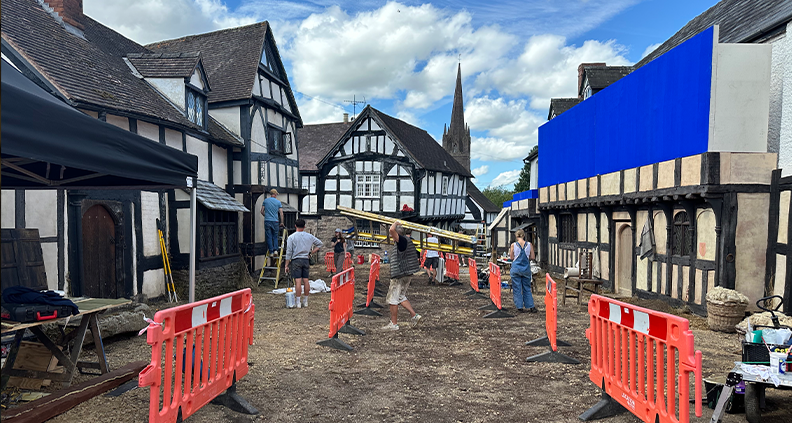
That contained world and palette restriction is really exciting in the design process. The Henley house, Shakespeare’s family home, was drained of color. Until Agnes arrives, the only color there is the blue on Will’s costumes — they are blue because his head is in the clouds. So, in the set design, we add hints of blue wherever he was. But if he doesn’t dominate a space, we’d go for very tonal browns, creams, and little threads of color. Will had his writing area, which Paul wanted to be messy, with ink all over the desk. When Agnes arrives, red and green start coming in because she brings the outside world into his life. The red of her dresses spilled into the A-frame set in the attic of the Henley house. Agnes’ mother, Rowan (Louisa Harland), was much freer and had color and nature in the flashbacks. But as Agnes gets older, her stepmother, Joan (Justine Mitchell), strips the colors out. So, her safe place was the apple shed, which brings nature inside.
The color palette here reminds me of the evolution in Agnes’ costumes as the story goes from love and hope to grief and loss. How closely did your team work with Malgosia Turzanska’s costume department?
Each character had a palette, as time moved on, it would change with them. We worked very closely with costume, so our set dressing changes with what Agnes wears. As she went into grief, her dress went to dark gray, purple, dark brown, so the bed drapes also change from the washed-out burnt orange to a grayish blue. You can really see it in the film. Even if someone’s not registering them [visually], you can feel the mood in the room shift. We worked with Malgosia and Chloé, who talked about the “rose period” and the “blue period.” The palette was very intentional.
What changes were made once the children were born?
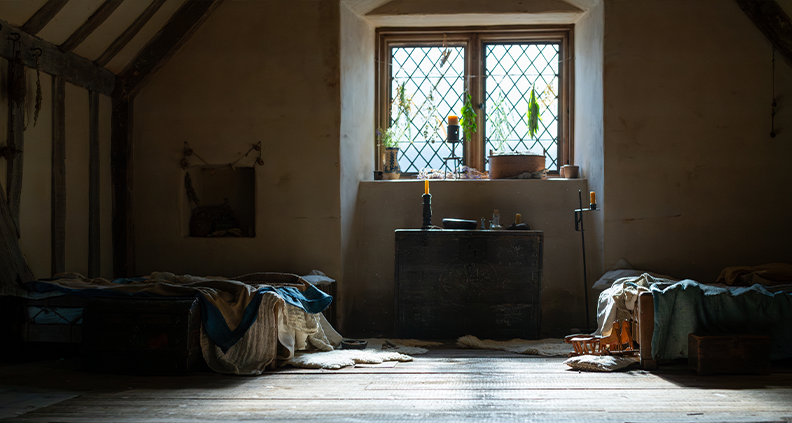
Once Agnes and Will get married, they move upstairs into the A-frame. As the children were born, color seeped into the bed drapes. Both the Henley house and the A-frame were set builds. Each baby had a baby blanket that Agnes made, which we aged it throughout their life so it has different colors for each child.
Let’s talk about dressing the attic with the twins’ beds, where mournful scenes take place later in the story.
We had a dressing plan for each time period. We wanted that attic space to be very playful for the children, they had little nooks where they kept their things, the beds, and washing and dressing areas. At one point, there’s a little play tent made of sticks and their bed spreads. They never make their beds because Agnes is very free, she just wants to like be in nature. So, their beds are always unmade, there’s a looseness to it. After Hamnet dies, one of the beds is removed; that’s when joy leaves the space. His bed would have been burnt — it was filmed but lost in the edit — anyone who died of the plague, you would burn all of their bedding, everything. So, in the garden, Agnes’ brother Bartholomew (Joe Alwyn), burnt Hamnet’s bed, his baby blanket, everything that was associated with him. A lot of people have said they noticed the change in that room. The A-frame has Will and Agnes’ marital bed and the twins’ beds, we made all of them. When Hamnet dies, one of the beds is gone, so the space dramatically changes, the drapes change, and we stripped out quite a lot of the playful dressing. The atmosphere in the house was changed.
I loved the details surrounding Agnes’ apothecary instruments, the herbs, flowers, treatments, and ointments. Can you talk about that?
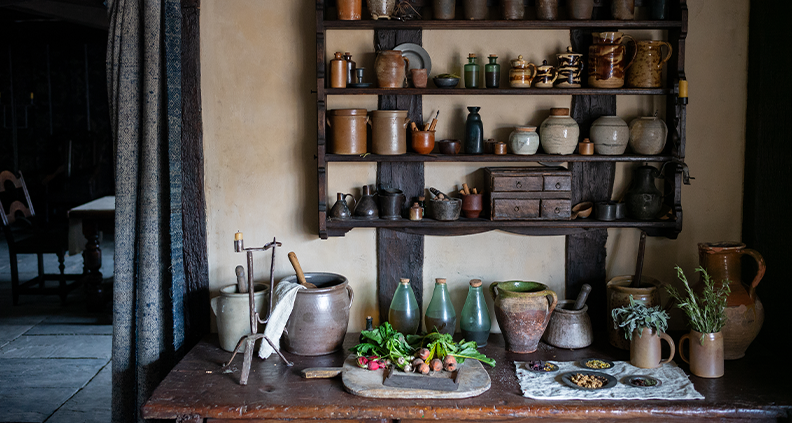
Maggie O’Farrell had done so much research, so the book was full of details. That all stems back to Shakespeare’s writing, which is full of botanicals, herbs and plants, and the reference to the flowers and herbs that Ophelia has in Hamlet. We grew an herb garden in Elstree Studio, so we had the real herbs that we bought from a historical herb place called Jekka’s. We also had an onset herbalist advisor, Kim Walker [a consultant at the Economic Botany Collection and the Antonelli Lab at the Royal Botanic Gardens], who teaches herbalism. She advised us on how to lay the herbs out and mix them. Everything that Jesse did on set was actually the correct herbs to make what she was talking about [in the scene]. Jesse even went foraging with Kim. There was a lot of research, thought and care that went into everything we see on the screen.
What went into building Agnes’ herb garden?
Very early in the process, we bought a lot of herbs, grew and dried them. My florist, Amanda Willgrave, helped us plant three big beds of herbs. We’d cut the flowers, which were all historically accurate. We cut herbs for the garden, they got quite leggy and big and bees and would visit them. Kim worked with the initial scripted herbs that were being mixed and helped us plant our garden with Amanda’s help. Kim also worked with Jesse in foraging and showing her how to pick and strip the herbs correctly.
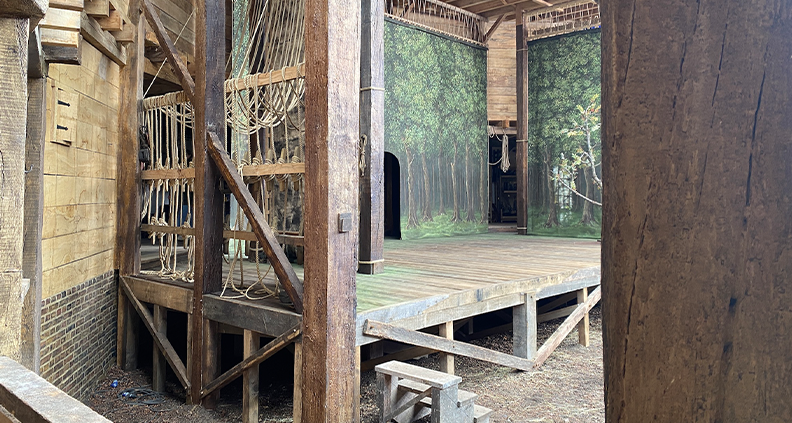
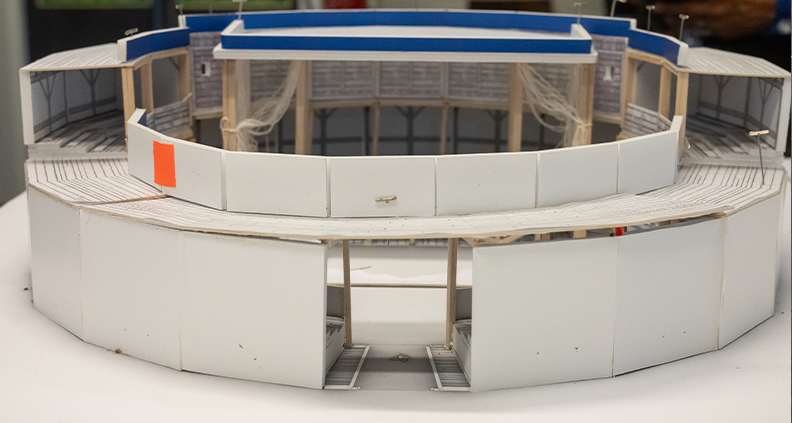
In the cathartic and gut-wrenching final sequence, Agnes finally comes to terms with the grief of her son’s death, when she watches the stage debut of Hamlet at Shakespeare’s Globe Theater. What went into constructing that set?
Chloé and Fiona went to see the original Globe Theater, but there were a lot of problems: it’s the middle of summer and that’s their biggest season for plays. Chloé really wanted it to be more intimate, so the decision was made to build it. She wanted it to feel like the inside of a tree. So, that Globe stage was constructed with reclaimed wood — our art director knew someone that was taking a barn down in France. Our amazing construction company reconstructed the huge beams to make the circular wooden Globe — you felt like you were inside of a tree, since a lot of aging was already in the wood.
Where was this set built?
We were in Elstree Studio. Henley house was built angled for the sun to come through the windows. We didn’t use greenscreen, it was real greenery and real sky behind it. The Globe was right next to it and both attics were there as well. They were all built simultaneously.
The sequence hinges on Agnes’ reactions as she watches the play, so a significant portion of it is the Hamlet stage play unfolding on-stage, with Will playing the ghost.
The amazing thing was we got to do the whole backstage of the Globe. Chloé ran the play like you would for real, so the players were Shakespearean players, we had all the props and everything was period-accurate. Even the standbys were in full costume with the props, armor, lantern, and swords. In Will’s makeup area, we used oyster shells, which were commonly eaten and thrown on the street, as a dish to mix the paints in; that comes from a reference of how Rembrandt would mix his paints. It wasn’t just Hamlet that was playing, there was other plays. So, we had nice details like the flags outside: if it was a comedy, it would be one color, and a tragedy would be a black flag. They’d have food, so we had sellers outside the Globe selling dried fruits. It was muddy. It was a very visceral experience, it really felt like we were in a play instead of on a set. It felt like we had built a theater. It was an amazing construction and decoration collaboration.
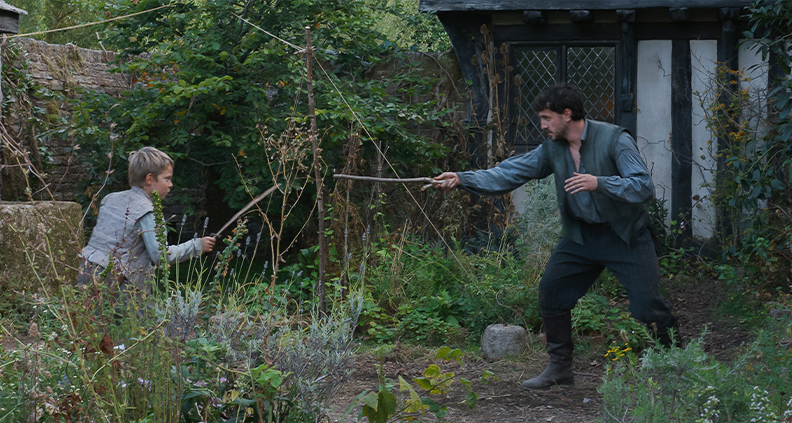
Hamnet is playing in select theaters for a post-nomination run and available on PVOD.
To learn more about the film, please join us this Thursday, February 26, for an intimate conversation with writer-director, Chloé Zhao, in “An Evening With …. Chloé Zhao.”
Film Independent promotes unique independent voices, providing a wide variety of resources to help filmmakers create and advance new work. Learn more online and become a Member of Film Independent today.
Keep up with Film Independent…
Featured Image: Jessie Buckley stars as Agnes Shakespeare in ‘Hamnet.’ Photo Credit: Agata Grzybowska / © 2025 FOCUS FEATURES LLC