Sculpting Emotional Gravity through Classical Music with the Composers of ‘Behemoth!’
In Spirit Award winner (for Nightcrawler) Tony Gilroy’s drama set in the classical music world, Pedro Pascal plays Alex Serian, a classical cellist mired in relationship troubles and family dysfunction ensnared in a midlife crisis. Thanks to a fanatical, wealthy patron of the Chicago Philharmonic Orchestra, Carol (Spirit Award winner for Booksmart, Olivia Wilde) – who refuses to let him go after he ends the affair – he is forced to leave the orchestra and return to his family home in Los Angeles. Along the way, ramifications from a failed relationship with the love of his life, Nadia (Eva Victor), return to haunt him.
Behemoth! is most unique in the way that the story is told sonically through music: the film’s emotional beats are communicated via 17 classical music compositions that had to be written and recorded prior to principal photography. In Alex’s journey of healing, discovery, and redemption, the music is the story. To pull off this ambitious feat, the Behemoth! Collective comprising of nine renowned composers was formed to score the film.
Composers Nami Melumad (Thor: Love and Thunder) and Emmy-winner Brandon Roberts (Andor, Free Solo) recently spoke to Film Independent about their incredible experience in depicting their profession on the silver screen.
What was your reaction when you read the script?
Roberts: I thought this is going to be very challenging because the music is so integrated into the actual shoot. I also couldn’t believe that a movie like this is going to get made. All the transitions are written in the screenplay – Tony really had this mapped out in his head. A lot of times you have an idea of what it’s going to be based on the screenplay and then when you see the movie, it’s totally different. But this was one of the few where it was one to one.
Melumad: It’s one of the most ambitious projects I’ve ever seen. In the film music world, to score a film before there is a film is something that I’ve never seen before. I thought it was the coolest thing ever. I’m really excited to be a part of it.
What was it like to collaborate with nine composers within the Behemoth! Collective?
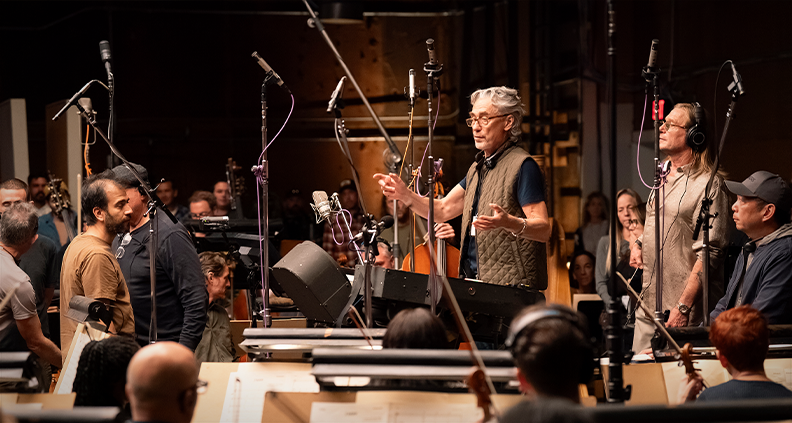
Roberts: It was right on point with how we normally work, which is very secluded. The way Tony wrote it, it’s supposed to be separate pieces and the continuity comes from Lukas’ [Frank] pieces joining them together. They are supposed to feel separate, so he was smart to have us all working on our own. When we got to hear each other’s pieces and demos, it was humbling and inspiring. It pushes you to try something new. During the scoring sessions, we got to hear each other’s music, see these amazing composers record their pieces, and hang out with our friends, that’s when it all came alive.
Melumad: When I got to hear James’ [Newton Howard] piece – the Viviana cue that plays when she plays the piano – that was very inspirational and that’s when I the screenplay come to life for me. You have to write the music to a film that doesn’t exist yet based on the screenplay, so listening to the other pieces helped me envision more of the tone and what’s it gonna feel like, which was very helpful. Seeing how James conducts himself on the stage and give notes to the orchestra or how Emily [Bear] does it, that was really interesting because I rarely go to other people’s sessions. So, it was exciting to see a different style and how their team operates. We each brought our own orchestrator but shared the music editor, conductor, and engineer Dennis Sands [music recorder and mixer]. He plays the engineer in the movie, by the way.
Roberts: He shows up in the first scene.
You had to compose the music before you saw any footage from the shoot?
Melumad: Yes, because when you’re filming the orchestra in the room, we wanted it to feel authentic, so they needed the pieces ahead of the shoot. Even though the orchestra can do it easily within 10 minutes, Pedro Pascal had to learn the cello.
It was unbelievable to see Pedro as a virtuoso cellist!
Melumad: I’m impressed. He took five or six hours of cello lessons every day! So, we needed to write the music well ahead of time, especially for the scenes where he’s playing on screen. He would need time to learn it and make it look real. At least with my cue, I wanted to make it as easy as possible for him so that it was doable. He had a lot of other very virtuoso and difficult technical things to learn for the film, so I tried to be very mindful of that in my cue.
The movie opens with Alex desperately running away from Carol. He flies down the stairwell with his cello and right into the blizzard. The suspense and fear in that piece, ‘Spies Don’t Run – Duende,’ made it feel like a Jason Bourne movie.
Roberts: Henry Jackman wrote that one. What a way to start the movie, it’s such a great cue and so comically perfect.
Melumad: And it works really well for the trailers too.
Roberts: It immediately sets the tone for the rest of the film to be larger than life – it gives permission for the over-the-top, dramatic story.
Let’s talk about your piece, “Look Away Jones,” which has a ’70s zippy vibe to it.
Roberts: It’s where Alex goes to his family’s storage facility while listening to his brother’s podcast, and at the same time, we play the theme which his dad (Peter, played by Hank Azaria) wrote for this fictitious TV detective series called “Look Away Jones.” Tony and I are both guitarists and when we were working on Andor, we talked about my history as a jazz guitarist. I’ve never done a jazz score, ironically, so when this popped up, he gave me the jazz cue.
What did you aim to communicate through this piece?
Roberts: I was trying to channel that time period and did a lot of research on old TV scores back then, a lot of Quincy Jones and Buddy Rich. We got one of the best bands for this, a 30-piece band, it was unbelievable.
How long did it take you to compose this piece?
Roberts: A few days including the research.
Nami, yours are the two “Tolerance Hill” pieces. Let’s talk about those sequences.
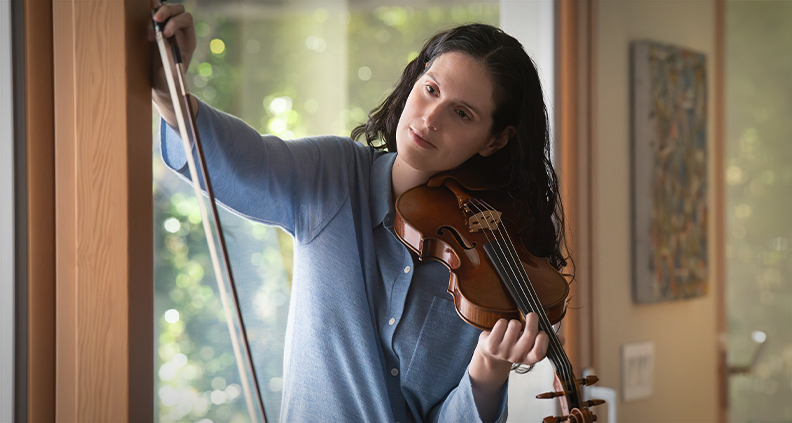
Melumad: I worked on the cues that featured the harp, when Alex visits his childhood home and sees his mom [Ginnie, played by JoBeth Williams] and her harps before going to Nadia’s funeral. There’s also the cue for the brief scene on the scoring stage, where the film playing features a lot of candlelight and a woman coming down the staircase in a Victoria outfit. That had to communicate the Victorian vibe, sense of nostalgia and longing, which then goes into Alex’s world. Then, you see the harp player doing these glisses, the camera goes through the harp to Pedro’s face and him playing the cello, then we cut to the house. It’s a very artistic shot, so I had to make it work timing-wise with what Tony wanted in the screenplay. Originally, Alex is just part of the orchestra, but I decided to go into a solo cello after that because it made sense to put the cello and harp together.
Part of Alex’s emotional makeup is his dysfunctional family, especially with his parents’ relentless push to force him onto the path of a music prodigy from the age of six.
Melumad: Yeah, it carries a lot of happy and painful memories especially with the clouded relationship between the parents. His mom is very upset and still longing for the dad, which is a very delicate emotion to capture, with a bit of nostalgia and also Alex’s overwhelming feelings as he prepares to go to Nadia’s funeral. So, it’s a very delicate scene and you don’t want to overpower it. Tony came over to help with the timing of that scene. He actually acted out the scene in front of me – since we didn’t have picture at that point – to help me understand the scene. He described everything while I timed it into my key base. I’ve never worked with a director who did that, which was so inspiring.
Nami, you actually have a role in the film!
Melumad: Yeah, I asked Tony if I could be part of the of the movie and play in the orchestra, and I play the flute.
How did your acting debut go?
Melumad: It was really fun! They sent the pieces by James Newton Howard and Alan Silvestri for us to practice. I practiced a bit since I’m a little rusty – I mainly do scoring now. But I really wanted the experience of being on set. I was there from 4am till 7pm. Brandon, James, Lukas stopped by – I think that’s when we first met. Just playing James and Alan’s music helped me understand the writing a little better. We worked on the same pieces over the four-day shoot for two sequences, when [conductor] Timo (Thomas Kretschmann) comes to the orchestra and when Pedro goes to find the toothbrush. The other cue was the one towards the end with Viviana – she comes over and says “Hello, flutes!” which was a nice acknowledgement to us. I wore a pink shirt in one scene and a brown coat in the other.
This story takes us through the film scoring process on a soundstage, which is rarely depicted to such detail on film. What is it like to see what you do for a living on the screen?
Melumad: I’m very honored and grateful to be part of it because it’s so iconic. I think it’s the first time that something like this has been done on screen. It’s a memorable and iconic movie about what we do and love and the musicians in L.A. So many musicians in the film are working musicians that Brandon and I have worked, so it’s incredible. It’s a pure celebration of film and TV music.
Roberts: I feel the same way. Even when we were reading the script, we knew it was a once-in-a-lifetime experience. I think that Tony coming off Andor had enough clout to get this made and his love of music really shines through. When you’re in the industry, you take for granted how it works, and this is a great opportunity to show everybody how the sausage is made, and it’s done very accurately – Tony spent a lot of time with research. Like Nami said, seeing the same musicians that we’ve known for for decades getting their day in the sun is great.
Melumad: Almost all the musicians in the film are professional musicians who do scoring sessions in L.A. It really celebrates their talent – going on that stage and reading a new piece of music you’ve never seen before and deliver a fantastic performance within three takes, which is like 10 or 12 minutes, is absolutely crazy. When we see Alex’s virtuoso level in the film, that’s the level expected of these musicians.
Roberts: I’m so proud to be associated with this group. I never thought I would share screen credit with someone like Alan Sylvestri. Getting to meet and work with Naomi, Emily, and Lukas was the coolest part of this.
Released by Searchlight Pictures, Behemoth! will be playing in theaters nationwide on December 4.
Want to vote for the winners of the 2027 Spirit Awards? Only Members get to vote to decide the winners. You’ll receive online screeners for the nominated films and shows this award season, not to mention year-round access to a plethora of virtual and in-person screenings, special events, education, workshops and more, so we invite everyone to Join. Watch. Vote.
Film Independent promotes unique independent voices by helping filmmakers create and advance new work. To become a Member of Film Independent, just click here. To support us with a donation, click here.
More Film Independent…
Title image by Justin Lubin/Searchlight Pictures. Courtesy of Searchlight Pictures