
Case Study: How ‘Deepfaking Sam Altman’ Takes on the Legality of A.I.
A.I. continues to be a hot-button issue in filmmaking circles. Despite plenty of valid ethical concerns, it’s use is only growing. A huge part of those concerns has to do with copyrightable material. What is protected as both an input, the human created material an AI model was trained on, and output, the newly generated AI content, is at the heart of this.
As part of this year’s Forum, we looked at all the legal implications of both inputs and outputs with a case study, Deepfaking Sam Altman. Legal expert Lisa Califf spoke with director Adam Bhala Lough about the film, a gonzo documentary that explores what it means to use AI technology.
The film follows Bhala Lough as he attempts to interview Altman, fails, and then goes to India to build a digital version of Altman he calls “Sam-bot” with AI expert Divyendra Jadoun, know online as “the Indian Deepfaker.”
To train the Large Language Model (LLM), they input as much publicly available information on Altman as they could find. Califf, who also acted as a lawyer for the film, noted that for Fair Use consideration, the legal team needed to know exactly what information the LLM was trained on. “What the Copyright Office wants you to do, which tricky, is identify what’s AI and what’s human created so that there’s an accurate record of what this work is and what’s protected and what’s not,” she said.
Bhala Lough then went a step further and decided to let Sam-bot direct the rest of his film, which created more legal questions. Califf said that after some discussion the copyright issue was easier here because instead of the AI generating the content, something which is not copyrightable, the bot was telling what the humans what to do, and because the content was created by humans, it was legally protected. Don’t worry about AI directors just yet, because the Sam-bot’s direction was terrible, and most of the time, unshootable.
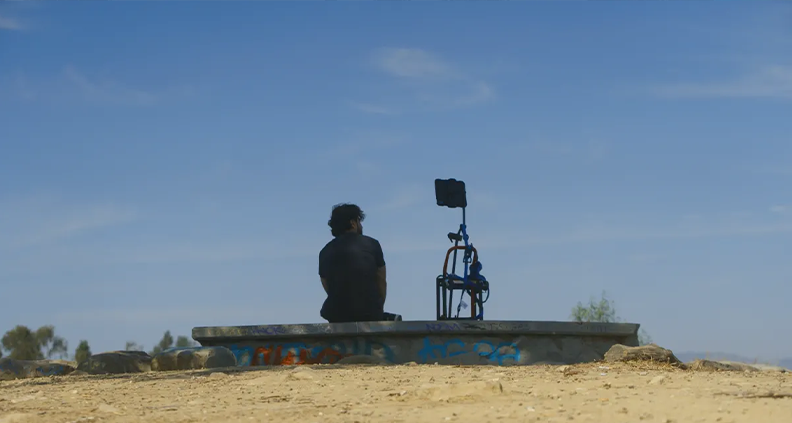
Another issue was featuring a public figure like Sam Altman without his consent. Califf explained that in the U.S., the First Amendment offers an exception for artistic expression as long as it’s clear that there is no deception involved.
“I do think in the future, if someone wanted to do reenactments or if someone wanted to do a documentary on Frank Sinatra or someone else who had passed away, what’s prohibiting them from using AI rather than using archival and reenactments? Honestly, I don’t think anything is. I think you could do that as long as the audience understood that this was a digital replica,” Califf said.
Looking at scripted content, Califf talked about the copyright issues with AI generated scripts. “People have this overarching fear of studios are going to use machines to write scripts. If the studio doesn’t have copyright over a script, they’re not going to put millions and millions of dollars in creating a movie that someone else can just create a version of. They wouldn’t do that.”
When it comes to copyright for AI-generated material that is in the style of a creator, courts are coming to the decision that the output has to be substantially different than the input. “One of the cases in particular, I think even had parameters on it, like you can’t use more than 50 words from one of these books at any one time,” Califf said. This is because it would harm the marketability of the original creator.
Finally, when it comes minor enhancements like up-rezing SD footage or cleaning up audio using AI tools, Califf said that as long as it’s clear that the material is original to the film, there isn’t a copyright issue.
Copyright is an important issue when it comes to AI use in films, and having a clear legal plan can make obtaining both Fair Use clearances and Errors & Omissions insurance much easier when it comes time to distribute. Something that both Califf and Bhala Lough emphasized throughout was how important transparency about AI use is throughout the process. AI is a new frontier, but with forethought, careful tracking of material, and a good legal plan, it can be a powerful tool that can be used in a way that is transparent and additive to a project.
Film Independent Artist Development promotes unique independent voices by helping filmmakers create and advance new work. To support our work with a donation, please click here. Become a Member of Film Independent here.
Keep up with Film Independent…